Thirty rights. One human family.
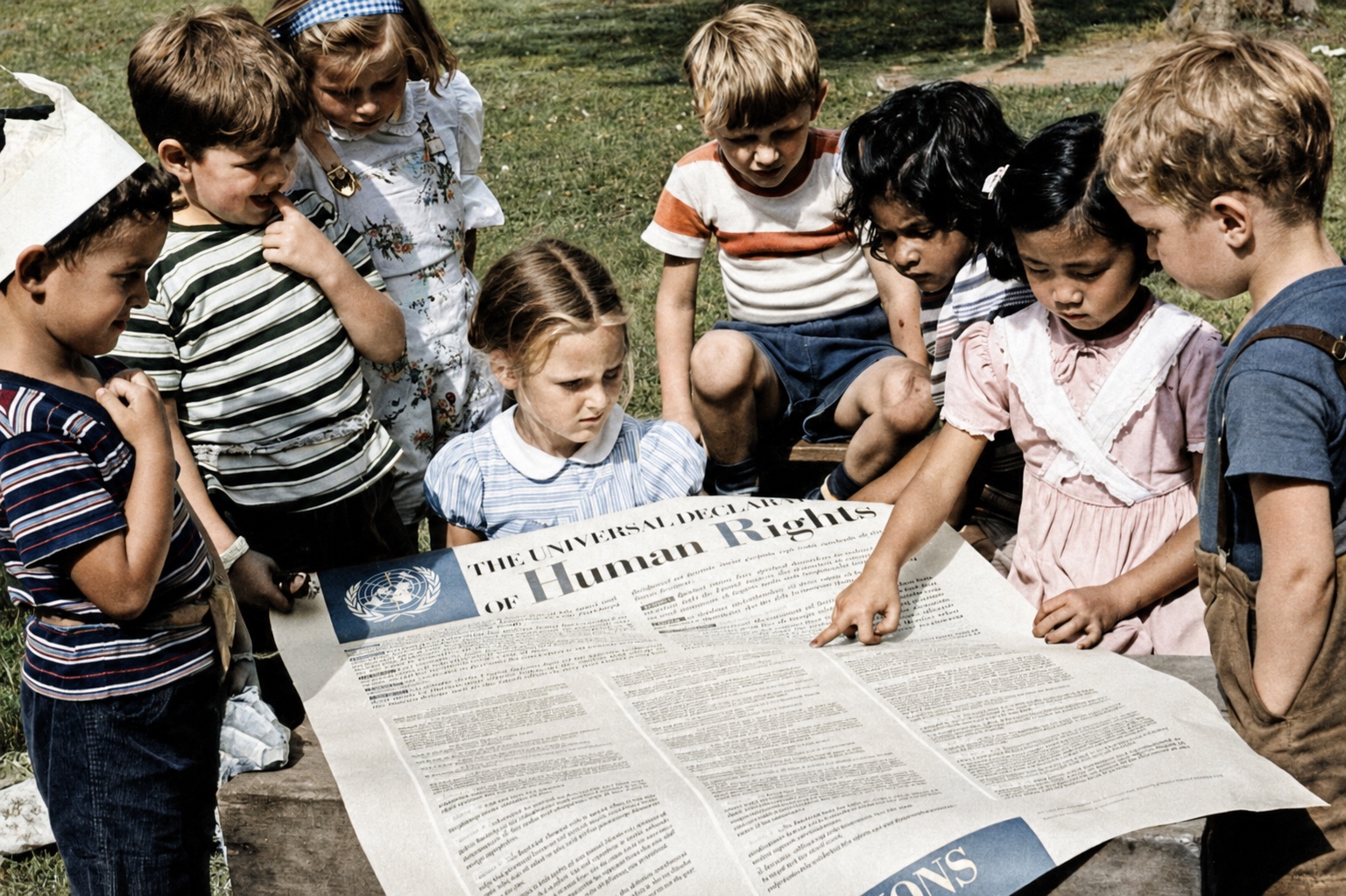
The Universal Declaration of Human Rights states the rights and freedoms that belong equally to every human being—and must never be taken away.
Adopted by the United Nations General Assembly on December 10, 1948, after the devastation of the Second World War, the Declaration was the first global statement that every person is entitled to dignity, freedom, and equal protection. It remains a common language for educators, advocates, and movements working to turn those principles into daily life.
Explore These Rights Here
Article 1We are all born free and equal
Read the article
All human beings are born free and equal in dignity and rights. They are endowed with reason and conscience and should act towards one another in a spirit of brotherhood.
Article 2Freedom from discrimination
Read the article
Everyone is entitled to all the rights and freedoms set forth in this Declaration, without distinction of any kind, such as race, colour, sex, language, religion, political or other opinion, national or social origin, property, birth or other status. Furthermore, no distinction shall be made on the basis of the political, jurisdictional or international status of the country or territory to which a person belongs.
Article 3Right to life, liberty and security
Read the article
Everyone has the right to life, liberty and security of person.
Article 4Freedom from slavery
Read the article
No one shall be held in slavery or servitude; slavery and the slave trade shall be prohibited in all their forms.
Article 5Freedom from torture
Read the article
No one shall be subjected to torture or to cruel, inhuman or degrading treatment or punishment.
Article 6Recognition as a person before the law
Read the article
Everyone has the right to recognition everywhere as a person before the law.
Article 7Equality before the law
Read the article
All are equal before the law and are entitled without any discrimination to equal protection of the law. All are entitled to equal protection against any discrimination in violation of this Declaration and against any incitement to such discrimination.
Article 8Access to justice
Read the article
Everyone has the right to an effective remedy by the competent national tribunals for acts violating the fundamental rights granted by the constitution or by law.
Article 9Freedom from arbitrary detention
Read the article
No one shall be subjected to arbitrary arrest, detention or exile.
Article 10Right to a fair trial
Read the article
Everyone is entitled in full equality to a fair and public hearing by an independent and impartial tribunal, in the determination of their rights and obligations and of any criminal charge against them.
Article 11Presumption of innocence
Read the article
Everyone charged with a penal offence has the right to be presumed innocent until proved guilty according to law in a public trial at which they have had all the guarantees necessary for their defence. No one shall be held guilty of any penal offence on account of any act or omission which did not constitute a penal offence under national or international law at the time it was committed.
Article 12Right to privacy
Read the article
No one shall be subjected to arbitrary interference with their privacy, family, home or correspondence, nor to attacks upon their honour and reputation. Everyone has the right to the protection of the law against such interference or attacks.
Article 13Freedom of movement
Read the article
Everyone has the right to freedom of movement and residence within the borders of each state. Everyone has the right to leave any country, including their own, and to return to their country.
Article 14Right to seek asylum
Read the article
Everyone has the right to seek and to enjoy in other countries asylum from persecution. This right may not be invoked in the case of prosecutions genuinely arising from non-political crimes or from acts contrary to the purposes and principles of the United Nations.
Article 15Right to a nationality
Read the article
Everyone has the right to a nationality. No one shall be arbitrarily deprived of their nationality nor denied the right to change their nationality.
Article 16Right to marry and form a family
Read the article
Men and women of full age, without any limitation due to race, nationality or religion, have the right to marry and to found a family. They are entitled to equal rights as to marriage, during marriage and at its dissolution. Marriage shall be entered into only with the free and full consent of the intending spouses. The family is the natural and fundamental group unit of society and is entitled to protection by society and the State.
Article 17Right to own property
Read the article
Everyone has the right to own property alone as well as in association with others. No one shall be arbitrarily deprived of their property.
Article 18Freedom of thought and religion
Read the article
Everyone has the right to freedom of thought, conscience and religion; this right includes freedom to change their religion or belief, and freedom, either alone or in community with others and in public or private, to manifest their religion or belief in teaching, practice, worship and observance.
Article 19Freedom of opinion and expression
Read the article
Everyone has the right to freedom of opinion and expression; this right includes freedom to hold opinions without interference and to seek, receive and impart information and ideas through any media and regardless of frontiers.
Article 20Freedom of assembly and association
Read the article
Everyone has the right to freedom of peaceful assembly and association. No one may be compelled to belong to an association.
Article 21Right to take part in government
Read the article
Everyone has the right to take part in the government of their country, directly or through freely chosen representatives. Everyone has the right of equal access to public service in their country. The will of the people shall be the basis of the authority of government, expressed in periodic and genuine elections by universal and equal suffrage and secret vote or equivalent free voting procedures.
Article 22Right to social security
Read the article
Everyone, as a member of society, has the right to social security and is entitled to realization, through national effort and international co-operation and in accordance with the organization and resources of each State, of the economic, social and cultural rights indispensable for their dignity and the free development of their personality.
Article 23Right to work
Read the article
Everyone has the right to work, to free choice of employment, to just and favourable conditions of work and to protection against unemployment. Everyone, without any discrimination, has the right to equal pay for equal work. Everyone who works has the right to just and favourable remuneration ensuring an existence worthy of human dignity. Everyone has the right to form and to join trade unions for the protection of their interests.
Article 24Right to rest and leisure
Read the article
Everyone has the right to rest and leisure, including reasonable limitation of working hours and periodic holidays with pay.
Article 25Right to an adequate standard of living
Read the article
Everyone has the right to a standard of living adequate for the health and well-being of themselves and of their family, including food, clothing, housing and medical care and necessary social services, and the right to security in the event of unemployment, sickness, disability, widowhood, old age or other lack of livelihood in circumstances beyond their control. Motherhood and childhood are entitled to special care and assistance. All children, whether born in or out of wedlock, shall enjoy the same social protection.
Article 26Right to education
Read the article
Everyone has the right to education. Education shall be free, at least in the elementary and fundamental stages. Elementary education shall be compulsory. Technical and professional education shall be made generally available and higher education equally accessible to all on the basis of merit. Education shall be directed to the full development of the human personality and to the strengthening of respect for human rights and fundamental freedoms.
Article 27Right to cultural life
Read the article
Everyone has the right freely to participate in the cultural life of the community, to enjoy the arts and to share in scientific advancement and its benefits. Everyone has the right to the protection of the moral and material interests resulting from any scientific, literary or artistic production of which they are the author.
Article 28Right to a free and fair world
Read the article
Everyone is entitled to a social and international order in which the rights and freedoms set forth in this Declaration can be fully realized.
Article 29Responsibility to the community
Read the article
Everyone has duties to the community in which alone the free and full development of their personality is possible. In the exercise of their rights and freedoms, everyone shall be subject only to such limitations as are determined by law to secure respect for the rights and freedoms of others and to meet the just requirements of morality, public order and the general welfare in a democratic society.
Article 30Rights cannot be taken away
Read the article
Nothing in this Declaration may be interpreted as implying for any State, group or person any right to engage in any activity or to perform any act aimed at the destruction of any of the rights and freedoms set forth herein.
Take part
Make human dignity part of every education.
Join a global community making peace education practical and widespread.